Colors and mana base
Count the color sources each color needs, then split your lands to give them those sources.
8 min read
After this guide you can
- Count the color sources a two-color deck needs.
- Split basic lands between two colors for a given set of pips.
Why one or two colors
Every colored symbol in a cost needs mana of that color. A deck of one color is called mono-color: every land casts every card.
A deck of two colors gets more good cards, and its mana still works. Each color after the second makes the mana go wrong more often.
A card has the colors of the mana symbols in its mana cost. The frame does not decide the color.
CR 105.1, 105.2
A number in a cost is generic mana, and mana of any color can pay it. A colored symbol needs mana of that exact color.
CR 107.4b, 107.4
What a colored source is
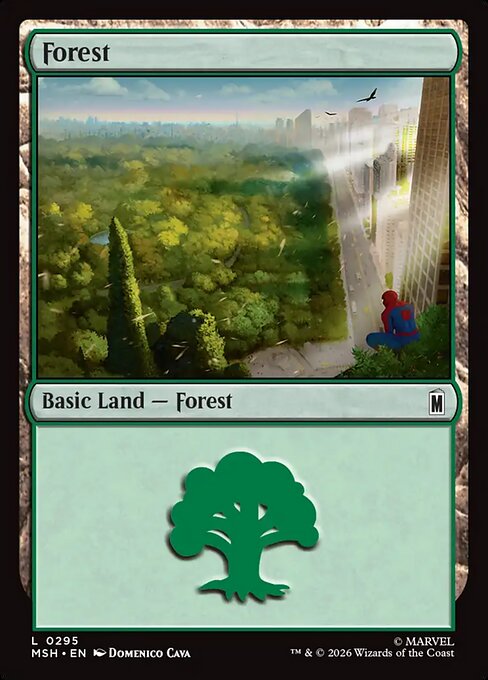 ForestBasic Land — Forest
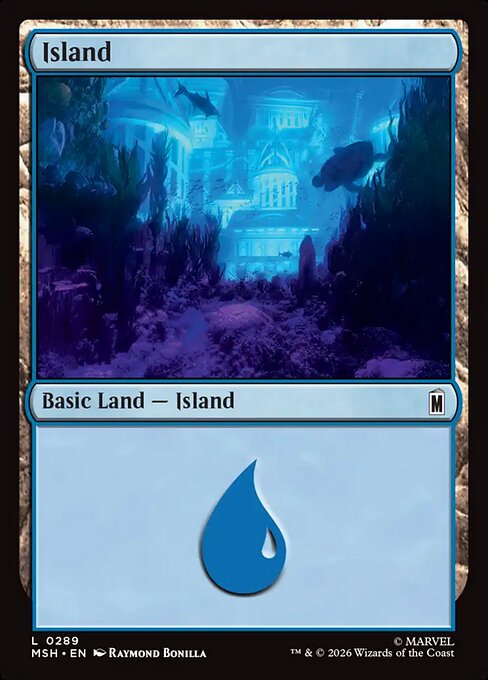 IslandBasic Land — Island
Forest, Marvel Super Heroes, illustrated by Domenico Cava. Island, Marvel Super Heroes, illustrated by Raymond Bonilla. Card images from Scryfall. Magic: The Gathering is a trademark of Wizards of the Coast. Marvel and all related character names are trademarks of MARVEL. BinderLoot is unofficial Fan Content and is not approved or endorsed by Wizards or by Marvel.
A colored source is a card that makes mana of one color. A Forest is a green source. An Island is a blue source.
Count your sources color by color, not your lands in total. Twelve Forests and twelve Islands are 24 lands, but only 12 green sources.
Each colored symbol in a cost is called a pip. {1} has one green pip. has two green pips.
Each basic land taps for one mana of its color: Plains for , Island for , Swamp for , Mountain for and Forest for .
CR 305.6
How many sources a card wants
Advice, not a rule
- 14
- sources for one colored symbol on turn 1
- 13
- sources for one colored symbol on turn 2
- 12
- sources for one colored symbol on turn 3
- 21
- sources for two colored symbols on turn 2
- 23
- sources for three colored symbols on turn 3
Frank Karsten counted the sources a 60-card deck needs to cast a card on time in about 9 games out of 10.
A cheap card needs more sources than an expensive one, because you want it on an early turn. Each extra pip of the same color adds a lot.
The card that needs the most sets the count for its whole color. One green card for turn 1 asks for 14 green sources.
How many lands
Advice, not a rule
- 20-28
- lands in a 60-card deck, fewest to most
- 22
- lands at average mana value 1.5
- 24
- lands at average mana value 2.5
- 26
- lands at average mana value 3.5
The average mana value is the total mana value of your nonland cards, divided by the number of those cards.
Start from about 20 lands, and add about 2 lands for each extra point of average mana value. BinderLoot stops at 28 lands, also for the slowest deck.
Why basic lands make two colors tight
Advice, not a rule
- 28
- sources that two colors of one-drops want
- 22-26
- lands in most 60-card decks
Say that both of your colors have a card for turn 1. Each color wants 14 sources, so the deck wants 14 + 14 = 28 sources. With basic lands alone, 28 sources do not fit in 22 to 26 lands.
A dual land makes either of two colors, so it counts as a source for both. Players call this mana fixing.
Worked example: a green and blue mana base
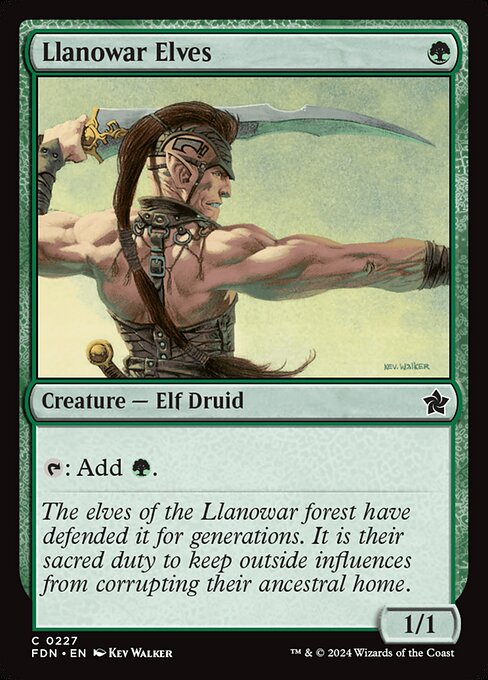 Llanowar ElvesCreature — Elf Druid · 1/1
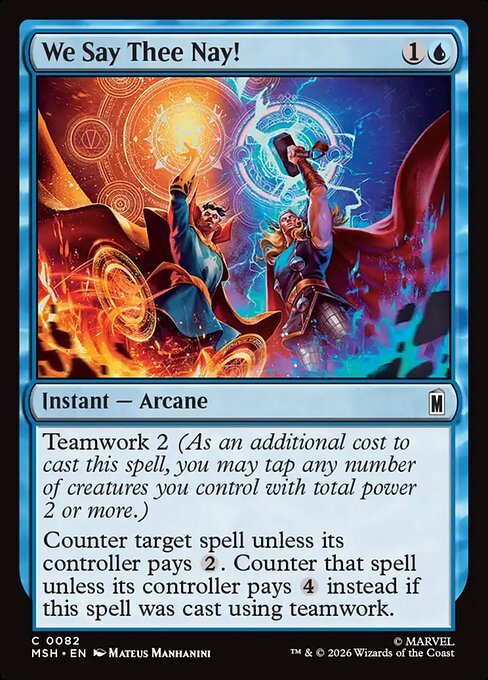 We Say Thee Nay!Instant — Arcane
- ForestBasic Land — Forest
- IslandBasic Land — Island
Llanowar Elves, Foundations, illustrated by Kev Walker. We Say Thee Nay!, Marvel Super Heroes, illustrated by Mateus Manhanini. Forest, Marvel Super Heroes, illustrated by Domenico Cava. Island, Marvel Super Heroes, illustrated by Raymond Bonilla. Card images from Scryfall. Magic: The Gathering is a trademark of Wizards of the Coast. Marvel and all related character names are trademarks of MARVEL. BinderLoot is unofficial Fan Content and is not approved or endorsed by Wizards or by Marvel.
- 1Your green and blue deck plays 24 lands. Find the card that needs the most sources in each color.
- 2Green: Llanowar Elves costs , and you want it on turn 1. That asks for 14 green sources.
- 3Blue: We Say Thee Nay! costs {1}, and you want it on turn 2. That asks for 13 blue sources.
- 414 + 13 = 27 sources, and the deck has 24 lands. Basic lands alone fall 3 short.
- 5A dual land of green and blue counts for both colors. Play 3 dual lands, 11 Forests and 10 Islands: green has 3 + 11 = 14, and blue has 3 + 10 = 13.
How the deck wizard builds it
Advice, not a rule
- 32
- nonland cards at the least in a wizard deck
The deck wizard reads your collection and builds a 60-card deck from it. It counts the lands from the average mana value, puts in the dual lands you own, and splits the basic lands by the count of each color.
It keeps at least 32 nonland cards, so its deck never holds more than 28 lands. It adds the basic lands a deck needs and lists the ones you do not own yet.
Your turn: split 24 lands
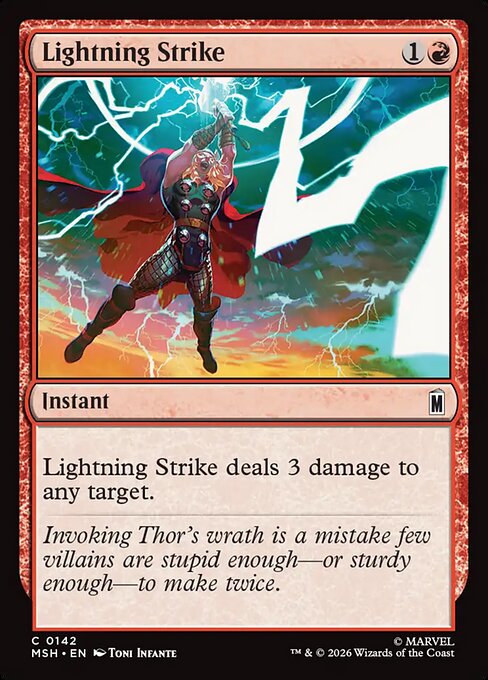 Lightning StrikeInstant
- Llanowar ElvesCreature — Elf Druid · 1/1
Lightning Strike, Marvel Super Heroes, illustrated by Toni Infante. Llanowar Elves, Foundations, illustrated by Kev Walker. Card images from Scryfall. Magic: The Gathering is a trademark of Wizards of the Coast. Marvel and all related character names are trademarks of MARVEL. BinderLoot is unofficial Fan Content and is not approved or endorsed by Wizards or by Marvel.
A red and green deck plays 24 lands and no dual lands. Its cheapest red card and its cheapest green card each cost 3 mana with one pip.