Building your first deck
Build a legal deck, count your lands, and give the deck a way to answer a threat.
8 min read
After this guide you can
- Build a legal 60-card list.
- Choose a land count from the average mana value of your spells.
How many cards
- 60
- cards at least in a normal deck
- 100
- cards in a Commander deck
- 4
- copies of one card
- A normal deck needs at least 60 cards, with up to four copies of each card except basic lands.
- A Commander deck holds exactly 100 cards, and the commander is one of them.
- A sideboard holds up to 15 cards. You swap them between games of a match. Commander uses no sideboard.
A constructed deck has at least 60 cards, with no maximum. It holds at most four copies of a card by name, except basic lands.
CR 100.2a
A constructed sideboard holds up to 15 cards, and the four-copy limit counts the deck and the sideboard together.
CR 100.4a
A Commander deck has exactly 100 cards, the commander included, with one copy of each card except basic lands. Commander uses no sideboard.
CR 903.5a, 903.5b, 903.5e
How many lands
Advice, not a rule
- 24
- lands in a 60-card deck
- 37
- lands in a Commander deck
Twenty-four lands in 60 cards is the number every source repeats. Frank Karsten measured the exact answer: 19.59 plus 1.90 times the average mana value of your nonland cards.
A Commander deck wants 36 to 38 lands. BinderLoot runs this math on your deck and states the number.
Your colors decide how those lands split.
- A fast deck of cheap cards, with an average mana value of 1.5: 22 lands.
- A balanced deck, with an average mana value of 2.5: 24 lands.
- A slow deck that wins late, with an average mana value of 3.5: 26 lands.
The mana curve
Advice, not a rule
- 2-3
- where the curve should peak
The curve counts your nonland cards by mana value. A healthy curve peaks at two or three mana.
Too many cards of five mana or more leaves you with nothing to do on the early turns.
Worked example: a first deck by the rule of nine
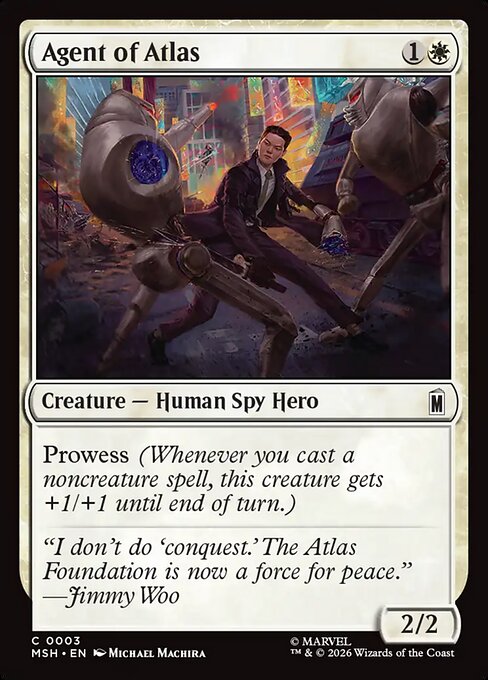 Agent of AtlasCreature — Human Spy Hero · 2/2
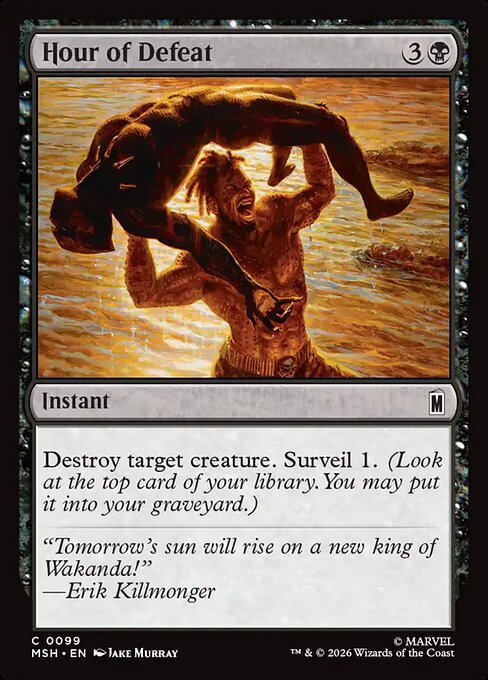 Hour of DefeatInstant
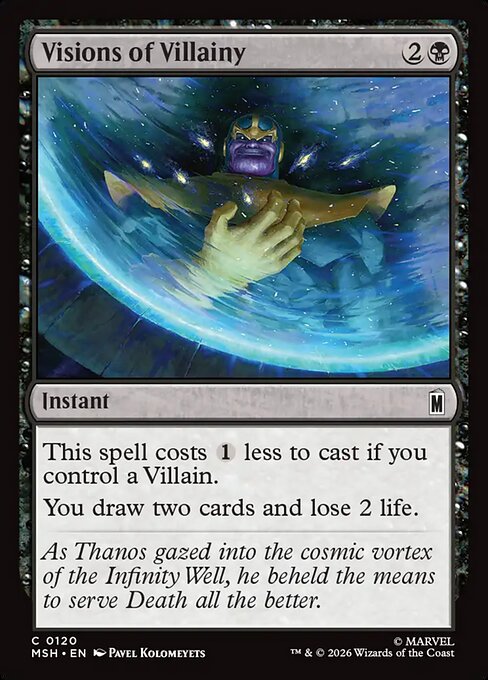 Visions of VillainyInstant
Agent of Atlas, Marvel Super Heroes, illustrated by Michael Machira. Hour of Defeat, Marvel Super Heroes, illustrated by Jake Murray. Visions of Villainy, Marvel Super Heroes, illustrated by Pavel Kolomeyets. Card images from Scryfall. Magic: The Gathering is a trademark of Wizards of the Coast. Marvel and all related character names are trademarks of MARVEL. BinderLoot is unofficial Fan Content and is not approved or endorsed by Wizards or by Marvel.
- 1Choose nine cards your deck needs. For example: five creatures such as Agent of Atlas, two removal spells such as Hour of Defeat, one card draw spell such as Visions of Villainy, and one big creature to finish the game.
- 2Play four copies of each. 9 × 4 = 36 spells, and four is the most a deck can hold.
- 3The 36 spells have an average mana value of 2.5, so the deck wants 24 lands.
- 436 + 24 = 60 cards. No card has more than four copies, and basic lands have no limit, so the deck is legal.
What a deck needs besides creatures
Advice, not a rule
- Hour of DefeatInstant
- Visions of VillainyInstant
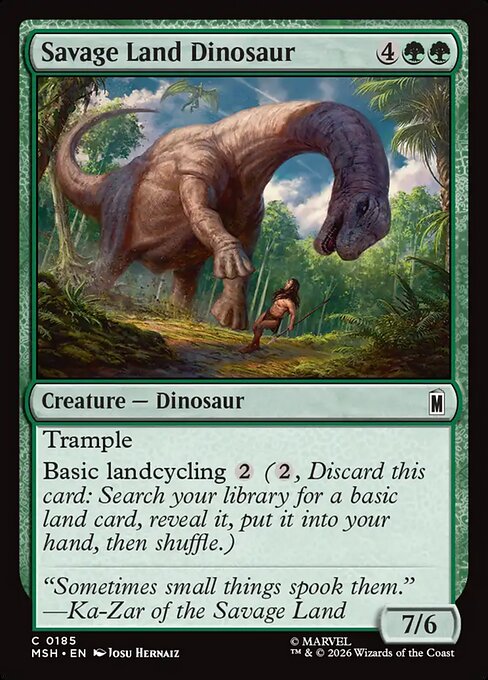 Savage Land DinosaurCreature — Dinosaur · 7/6
Hour of Defeat, Marvel Super Heroes, illustrated by Jake Murray. Visions of Villainy, Marvel Super Heroes, illustrated by Pavel Kolomeyets. Savage Land Dinosaur, Marvel Super Heroes, illustrated by Josu Hernaiz. Card images from Scryfall. Magic: The Gathering is a trademark of Wizards of the Coast. Marvel and all related character names are trademarks of MARVEL. BinderLoot is unofficial Fan Content and is not approved or endorsed by Wizards or by Marvel.
- Removal: spells that destroy, exile, or counter what your opponent plays. A deck with no answers loses to the first threat it cannot block.
- Card draw: a way to find more cards when your hand runs out.
- A way to win: creatures that end the game, or a spell that does.
Your turn: finish a deck
You chose nine cards and play four copies of each. The 36 spells have an average mana value of 3.5.